2018-03-02

Tightened requirements for the capital and asset quality of credit unions gave fruit – after two years of loss this sector became profitable again.
‘Credit union restructuring has strengthened this sector; we can see the first results of positive developments. Nevertheless, to achieve business sustainability, credit unions should devote more attention to cost analysis, notably operating costs.
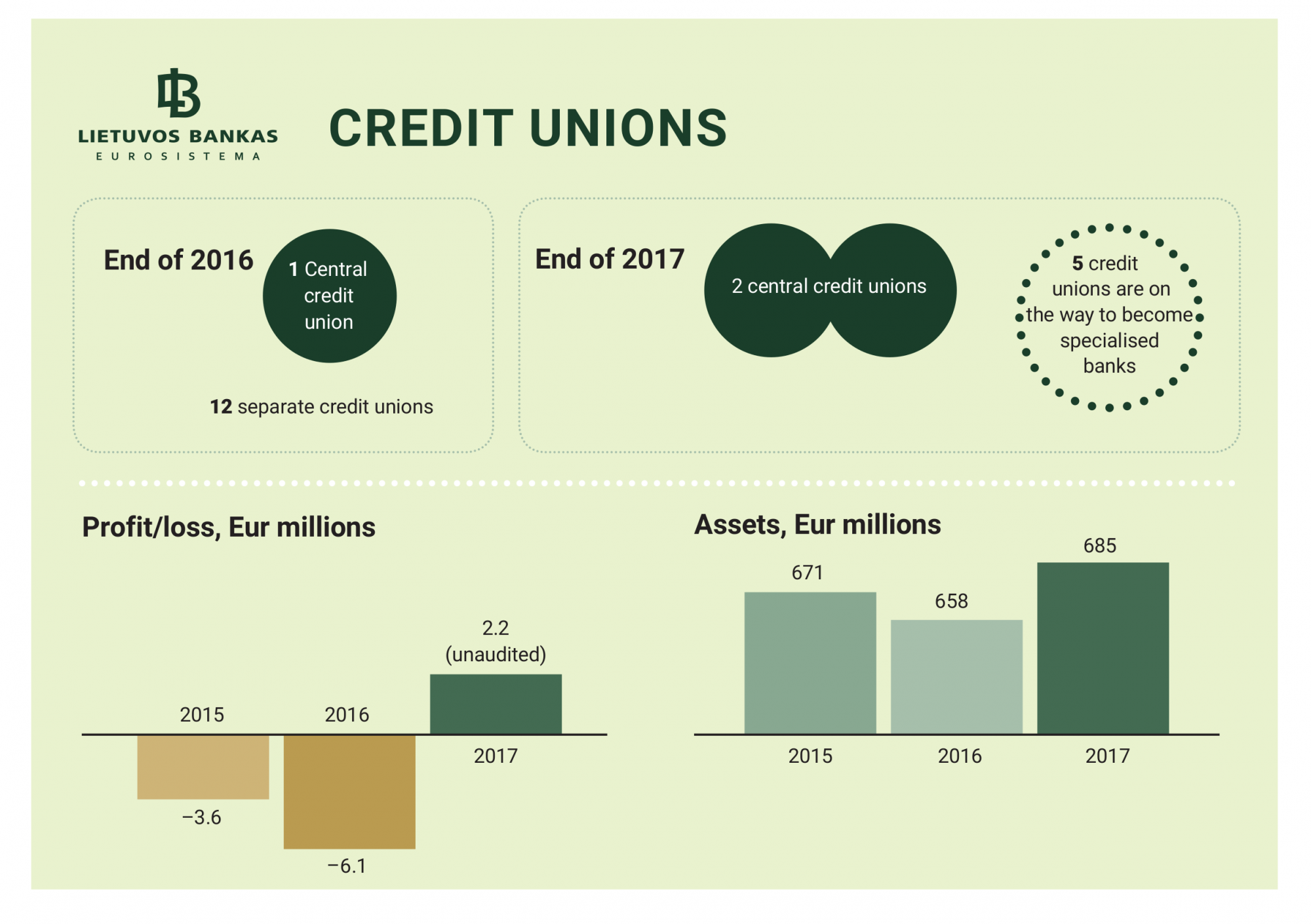
In 2017, the credit union sector’s unaudited profit amounted to EUR 2.2 million. 48 credit unions operated at a profit, earning EUR 4.1 million in profits; 20 unions sustained losses of EUR 1.9 million. Were it not for the losses sustained by two credit unions (EUR 1 million) for which licences were revoked in 2018, the entire sector’s unaudited profit would have amounted to EUR 3.2 million. In aggregate amounts, in 2016 credit unions bore EUR 6.1 million, in 2015 – EUR 3.6 million losses.
The assets of credit unions grew more than 4 per cent over last year, to EUR 685.2 million or 2.5 per cent of the banking system’s assets. The major share of them – almost 60 per cent – was comprised of loans. The loan portfolio expanded by a fifth (EUR 64.5 million) last year, to EUR 403.5 million. Other asset positions, notably security investments, decreased.
Deposits remained the major financing source for credit unions. Last year, their amount collected was almost by EUR 21 million (3.5%) larger than in 2016, a total of EUR 611.4 million. 90 per cent of credit union assets were financed with them. Time deposits increased the most – by EUR 16.1 million, due to higher interest rates. The interest rates increased mainly due to credit unions which aim at being restructured into specialised banks.
On 1 January 2018, financial and supervisory reports were presented to the Bank of Lithuania by 68 credit unions that united more than 160 thousand members. The system’s capital adequacy ratio stood at 18.64 per cent (the requirement is 13%), liquidity ratio – at 45.7 per cent (the required minimum is 30%). Seven credit unions did not meet the prudential requirements on the reporting date, almost twice as little as half a year before. They have now already remedied the situation and are in compliance with the ratios.
Over the last year credit unions had to take a decision whether to choose the restructuring-into-a-bank-procedure or continue operating as part of one of the two central credit unions in operation in the country. The majority chose the latter way: as of the beginning of the year, 50 credit unions operate as part of the Lithuanian Central Credit Union, while the established new United Central Credit Union unites 11 credit unions. Five credit unions chose the other way and, upon consent from the Bank of Lithuania, embarked on restructuring-into-specialised banks procedures. These developments will strengthen cooperative banking activities and allow to expand financial services for households and businesses.