2017-09-02

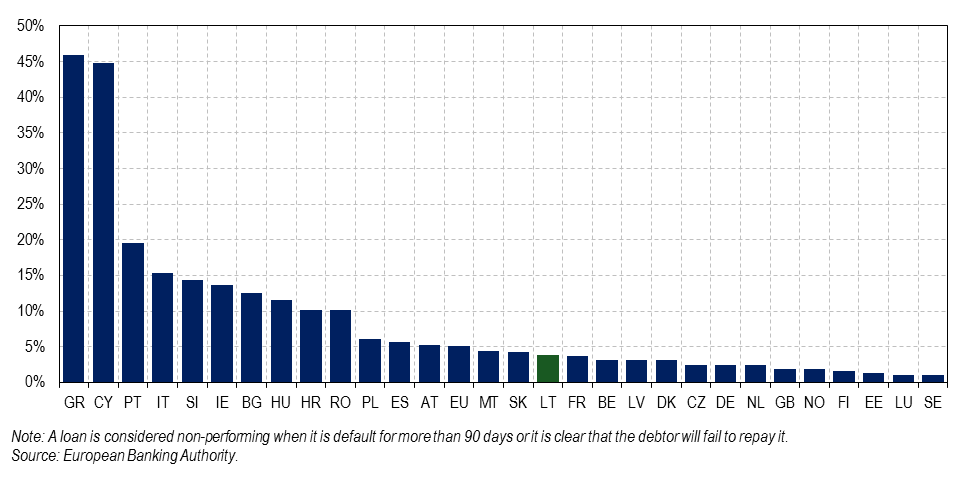
European banks suffer from bad (non-performing) loan syndrome, which hinders economic development. In recent years, the level of unpaid loans at European banks reached alarming heights, especially in Southern Europe. For example, in Greece and Cyprus non-performing loans account for nearly half of total bank loans, in Portugal – a fifth, in Italy – 15 per cent. Normally, the level of bad loans should not exceed 5 per cent, yet a third of European countries record levels higher than 10 per cent, with the total stock of such loans topping EUR 1 trillion. This not only diminishes the resilience of banks in these countries, but also weighs on their lending capacities, ultimately resulting in smaller inflows into the regional economy. Almost two thirds of Lithuanian exports make their way to the EU, thus any disturbances in the area lead to a fall in Lithuanian production sales, leaving our economic potential unfulfilled Expanding regional economy and recovering lending bring an air of optimism, but a firm foothold for many countries is impeded by the yet-to-be-solved issue of bad loans.
Comment by Jokūbas Markevičius, Principal Economist, Macroprudential Analysis Division, Bank of Lithuania
The main reasons behind the build-up in non-performing loans were the economic downturn, irresponsible lending, and lengthy recovery procedures. European countries incurred significant losses due to the euro area sovereign debt crisis in 2011–2012, which brought about a rise in the unemployment rate and disruptions in corporate cash flows; as a result, it became increasingly more difficult to repay the loans. Irresponsible lending policies that had been pursued until then were also a major contributing factor behind the growth in non-performing loans – seeking to maximise profit in the short-term, banks extended credits to debtors that were too risky. Currently the decline of non-performing loans is impeded by long and ineffective legal processes and heavy court load in certain EU countries. Often asset recovery or bankruptcy proceedings stretch over several years, making the non-performing loan issue a lingering problem.
An abundance of non-performing loans, a persisting and unaddressed issue, creates zombie banks. Under legislation regulating banking activities, banks must bear all underlying loss when a loan becomes non-performing. Nonetheless, some banks that are unwilling or financially unable to recognise losses tend to overvalue bad loans arguing that they will recover the sum borrowed in the long run, i.e. after the legal procedures are finalised or the value of repossessed collateral rises. Unfortunately, such assumptions are often false – the long wait simply postpones their recognition of losses, transforming these banks into ‘zombies’, i.e. banks that administrate bad loans rather than extend new ones. Granting of new loans is also restricted by shortage of own capital as banks are forced to set aside a larger share of capital to cover potential losses generated by bad loans.
Bad loans crush larger European banks as well. The wave of bankruptcies across Europe in summer 2017 was a perfect illustration that over time the burden of non-performing loans may become too heavy for banks to bear. At the beginning of June, Banco Popular, the fifth largest bank in Spain, became insolvent (its stock of non-performing loans amounted to nearly EUR 40 billion). Several weeks later Italy faced the same situation: two banks with extensive amounts of bad loans – Banca Populare di Vicenza and Veneto Banca – were deemed insolvent. The troubled banks, however, were resolved. Over a weekend losses incurred by Banco Popular were imposed on its shareholders, while the good loans, deposits and staff were transferred to Santander, another Spanish bank. Italy took a similar path – the good business was taken over by Intesa Sanpaolo, while the losses from bad loans were born by the shareholders of the insolvent banks as well as the Italian government. All this did not cause crises, yet resolution of larger banks may be more difficult and have a more widespread impact on the financial system.
Lithuanian banks managed to clear out bad loans, lending regained strength. In 2010, a fifth of total loans in Lithuania were non-performing; as a result, banks were forced to put a lid on their lending – in 2008–2015, their loan portfolio contracted by 17 per cent. Nonetheless, the level of bad loans has already dropped to 3.8 per cent, with lending once again becoming accessible. Such a positive turnaround was underpinned by the improving financial health of borrowers, rising collateral value and write-offs. Major banks managed to write off bad loans using cash injections from Scandinavian banks. In addition, these parent banks established management companies which bought repossessed collateral from their subsidiaries in Lithuania at a higher than market price, thus allowing banks to avoid more significant losses. However, the banking cleanse was hampered by ineffective recovery and bankruptcy proceedings in the country.
European institutions devote increasing attention to the issue of non-performing loans, exploring possible solutions. Publishing its official guidelines, the European Central Bank encourages euro area banks to manage their non-performing loan portfolios. The Council of Europe is also believed to introduce some changes as it is preparing an action plan to address the following structural problems behind the persisting non-performing loans: 1) heavy court loads and lengthy recovery procedures; 2) insufficient powers of supervisory authorities to force banks to write off their non-performing loans faster; 3) inefficient banks that ought to be resolved; 4) the underdeveloped secondary market, where banks could sell their bad loans. It is expected that initiatives for tackling the abovementioned issues will be implemented across the EU in the near future. Structural changes will help annihilate zombie banks as well as spur the EU and Lithuania’s economic activity, rendering the financial system more stable and reliable.
Chart. Share of non-performing loans compared to total loans in the European banking sector in early 2017