
2015-07-03
Housing lending regulation - a way to encourage the financial sector’s sustainable contribution to real economy

The proper implementation of macroprudential policy instruments, which strengthen the resilience of the financial system and decrease systemic risk, help to avoid real estate price bubbles and ensure the financial sector’s sustainable contribution to real economy — this is stated at the international high-level conference held by the Bank of Lithuania in Vilnius, including in a keynote speech by Vítor Constâncio, Vice-President of the European Central Bank (ECB).
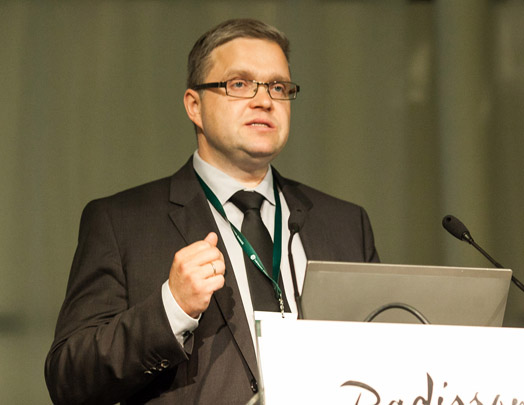
Vitas Vasiliauskas, Chairman of the Board of the Bank of Lithuania (Dainius Labutis (ELTA) photo)
“In the aftermath of the crisis, Lithuania was one of the first in Europe to apply housing lending regulation measures – the Responsible Lending Regulations were introduced already in 2011. At this conference we aim to share our experience with such instruments and together with other countries search for answers to the newest challenges in implementing macroprudential policy,” said Tomas Garbaravičius, Member of the Board of the Bank of Lithuania.
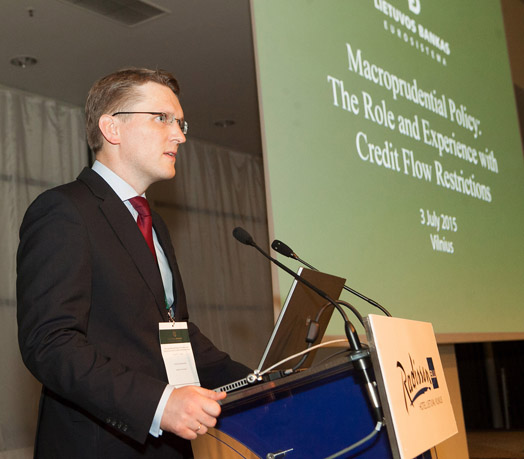
Tomas Garbaravičius, Member of the Board of the Bank of Lithuania (Dainius Labutis (ELTA) photo)
ECB Vice-President Vítor Constâncio called for the strengthening of macroprudential policy framework in Europe and the broadening of the macroprudential toolkit to constrain excessive credit growth and address excesses in the financial markets.
“This requires making efficient use of borrower based measures (LTVs, DSTIs), embed them in European legislation and ensure coordination between European institutions. Furthermore, it requires that macroprudential tools are extended to cover the shadow banking sector due to its increased role in financial intermediation”, he added.
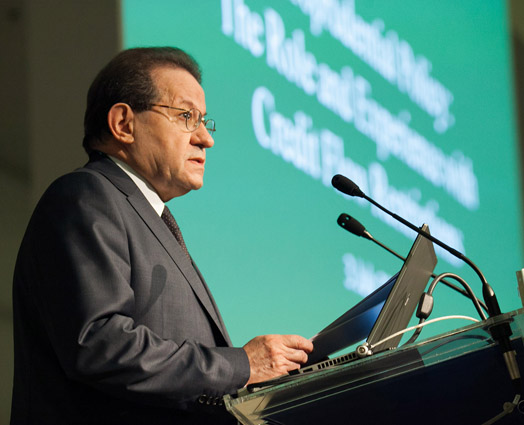
ECB Vice-President Vítor Constâncio (Dainius Labutis (ELTA) photo)
By using macroprudential policy instruments institutions seek to strengthen the resilience of the financial system against adverse shocks and to prevent the formation of systemic risks in order to ensure sustainable financial sector’s contribution to real economy.
In 2011 the Bank of Lithuania adopted the Responsible Lending Regulations, which introduced housing lending-related regulation instruments, such as the debt-service-to-income (DSTI) ratio and the loan-to-value (LTV) ratio. Lithuania was one of the first countries in the EU that implemented such measures. Currently, similar housing lending regulation instruments are applied in many EU countries.
At the conference in Vilnius issues will be discussed, related to the impact of the housing loan flow restriction instruments on the real economy and systemic risks, their effectiveness, their implementation and interaction with other instruments. At the conference, expert assessments will be presented, as well as scientific research and the experience of countries in identifying, implementing and applying these tools of macro prudential regulation. The event will bring together attendees who are high-level macroprudential policy makers and experts in this field. They have come to share their experience from the European Central Bank, International Monetary Fund, European Systemic Risk Board, EU, US and Asian countries institutions.
Speech by Vítor Constâncio, Vice-President of the ECB