
2014-05-13
For the people of Kaunas and visitors — unique opportunity to be the first to see the Lithuanian euro coins

The Bank of Lithuania’s exhibition, “Vytis: From the Lithuanian Denar to the Euro”, which opened today in Kaunas, is the only place where people can see our future currency: the 2015-issue Lithuanian euro with vytis, the figure from the Lithuanian coat of arms. The exhibition will reveal the historical journey of the vytis from the very first Lithuanian coins in the 14th c. to the future Lithuanian money — the euro.
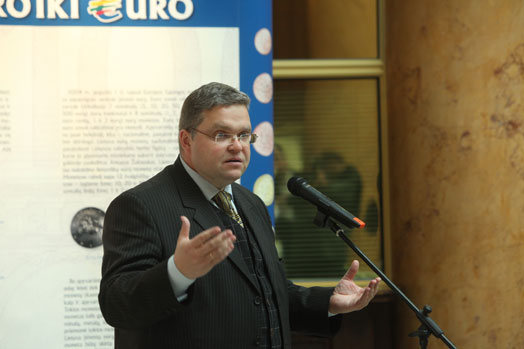
“The exhibition perfectly reveals that the national symbol of the Vytis has, for more than 600 years, been the axis connecting Lithuanian money over time. This tradition will be continued once Lithuania adopts the single currency of the European Union. The vytis will be incused on the national side of the circulations euro coins and, in ‘traveling’ from one European wallet to the next, will represent Lithuania,” said Vitas Vasiliauskas, Chairman of the Board of the Bank of Lithuania, at the exhibition’s opening event.
The Money Museum of the Bank of Lithuania organised the exhibition, which details the story of the Grand Duchy of Lithuania’s (GDL) coins from the end of the 14th c. to the early 18th c., the Republic of Lithuania’s coins and banknotes in 1978–1940 and our modern money, as well as introducing the future currency — the euro.
In the article printed in the exhibition booklet, historian Vidmantas Laurinavičius, head of the Bank of Lithuania’s Money Museum, explains that the coat of arms of Lithuania, the Vytis (a knight on horseback with a sword and shield, placed in an escutcheon), is one of the oldest in Europe. It fully formed in the 15th c.
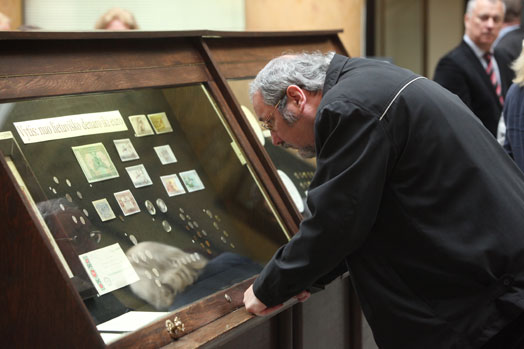
At the exhibition visitors will be able to view the old Lithuanian denars, half-groats, groats and other coins, banknotes with different depictions of the knight on horseback (vytis), as well as become acquainted with the euro coins issued by all of the European Union’s states that use the single currency. A games corner, installed in the exhibition space, will allow children to play educational computer games about the euro.
On 1 January 2015 Lithuania aims to adopt the single euro currency of the European Union — the euro. In all of the euro area countries, the 7 denomination euro banknotes are identical. Meanwhile, the 8 denomination euro coins have one common side and the other, national side, is different in each state. The decision was made to depict the coat of arms of Lithuania — the knight (vytis) — on the national side of the Lithuanian euro coins. The plaster models were created by the artist A. Žukauskas.
The Lithuanian Mint has already minted the first Lithuanian euro sample coins with the 2015 date and they can be viewed at the exhibition in Kaunas. All of the Lithuanian circulation coins will be suitable for payment in all of the euro area countries and other countries using the euro. Mass-minting of the Lithuanian euro coins is planned for the end of summer, when the decision of the Council of the European Union regarding the euro adoption in Lithuania will be announced.
The exhibition is located at the Kaunas branch of the Bank of Lithuania (Maironio g. 25, Kaunas). It is open Monday through Thursday, from 9:00 to 18:00 o’clock, and on Fridays until 17 o’clock. Entrance is free. It is planned for the exhibition to remain open until the end of June 2014.
About the vytis in Lithuanian currency
In the first coins of the GDL — the denar — the depiction of the knight appeared at the end of the 14th c. In some coins the knight is depicted as riding to the left, in others — to the right; in some he holds a spear while others show a sword; the horse can either be standing in place or galloping.
During the period of the rule of Grand Duke Vytautas (1392–1430), the knight on horseback became the coat of arms of Lithuania. At that time ir was not yet called vytis. The Lithuanian term “vytis” was used in our language later — in the mid-19th c. by Simonas Daukantas, as a synonym for expressing an ancient warrior, a knight on horseback. Vytis as the name of the coat of arms was first used in 1884 by Mikalojus Akelaitis.
During the reign of Grand Duke Alexander Jagiellon (1492–1506), the Mint of Vilnius began to mint denar and half-groat coins with a more artistic knight, incorporated into a circle; the clothing and small details of the horse and knight, depicted with armour, are visible. It is pointing to the left (heraldic — to the right) and is depicted as galloping; the horse’s tail is fully raised, but the knight does not yet have on his shoulder a shield with the double cross. It only appeared in 1535, with the minitng of groats.
Until the Union of Lublin (1569), the knight on the Lithuanian coins varied, his clothing details, helmets, shields were different and the horse was depicted sometimes with a raised tail, sometimes — lowered. In 1547 the coat of arms of the GDL was used for the first time on a coin (the knight is placed on a emblematic shield), with the duke’s hat above it. Until then, the knight had been represented separately, only as a figure of the coat of arms.
In the Republic of Lithuania in 1918–1940, in all issues of coins it was popular to use the depiction of the armoured knight on horseback, armed with sword and shield, as was created by the artists Juozas Zikaras. It had a fresh start on 11 March 1990, in the coat of arms of the restored Republic of Lithuania and was used in the first modern litas and cent coins, banknotes, and is well-known because of the horse’s lowered tail. On 4 September 1991, the Supreme Council of Lithuania confirmed the second version of the coat of arms, created by Arvydas Každailis and approved by the Heraldry Commission of Lithuania. This version depicts the horse with his tail raised. A. Každailis intoduced a new figure of the knight, adapted especially for coins; in 1997, the Lithuanian Mint minted the new issue circulation 10, 20, 50 cent coins, while in 1998 — the 1, 2, 5 litas coins. Their plaster models were created by the artist Antanas Žukauskas. The older issue larger denomination coins were withdrawn from circulation and the earlier version of the knight remained only on the 1991-issue 1, 2 and 5 cent coins still in use.
To date, the Bank of Lithuania has already issued nearly 100 collector and collector circulation coins. “The approved state coat of arms, or the figure specially adapted for the coin, has been used for the obverse increasingly rarer since 2003. Artists began to propose versions of the knight that were more varied and stylistically accurate to the period or theme portrayed. Both sides of the coin became uniform,” notes the head of the Bank of Lithuania Money Museum, Vidmantas Laurinavičius, also the author of the exhibition’s booklet.
The exhibition’s booklet in Lithuanian can be found here (2 MB download icon)