
Lithuania’s economic development and outlook
17 June 2026
The ongoing conflict in the Middle East is raising increasing concerns about the global economic outlook. Although global economic resilience continues to be supported by strong tech investment, including artificial intelligence, as well as by a more accommodative fiscal and monetary policy stance, the blockade of the Strait of Hormuz and stalled peace negotiations are adding to uncertainty surrounding the outlook for the global economy. The main sources of concern are elevated energy prices amid the ongoing conflict, increasing signs of disruptions in global supply chains, tighter financing conditions in global markets, and heightened geopolitical uncertainty. This uncertainty is also reflected in high-frequency indicators. For instance, the global Purchasing Managers’ Index (PMI) for March-May pointed to a markedly weaker development of the global economy than at the beginning of the year. It was mainly constrained by the services sector. An even stronger slowdown in global economic growth is, for the time being, being mitigated by the recovery in manufacturing; however, this improvement is likely to be temporary, as firms seek to frontload production in order to cushion the impact of rising price pressures and supply chain disruptions. Among the major global economies, the euro area faces the most pessimistic economic outlook. In May, the PMI signalled a contraction in economic activity and fell to its lowest level in the past one and a half year. Such developments in Lithuania’s main trading partner will have an adverse impact on the demand for goods and services produced in Lithuania.
The Lithuanian economy entered the year with somewhat more moderate growth. In the first quarter of this year, real gross domestic product (GDP) was 2.6% higher than a year earlier, representing a slight slowdown compared with 2025, when the economy grew by 2.9%. At the beginning of the year, the slowdown in economic growth was fairly broad-based, with value added across most private sector activities growing more slowly than in the previous quarter, reflecting the impact of a range of factors. For example, an unusually cold winter dampened activity in construction and real estate, as well as investment in buildings and structures. Weaker growth in real value added in manufacturing and slower growth in exports, particularly that of goods, were driven by a fading base effect associated with firms’ efforts to frontload production at the beginning of last year in anticipation of potential tariff increases. The transport sector was adversely affected by less favourable demand conditions for these services and by the conflict in the Middle East, which began on 28 February and significantly increased operating costs. Although the latter factor has introduced considerable uncertainty about the outlook, it has so far not led to a significant deterioration in business sentiment in Lithuania. Following a marked decline in March, the Lithuanian Economic Sentiment Indicator improved in April and May and is currently only slightly below its pre-conflict level. Such business sentiment can be partly attributed to a stronger demand for goods, as firms seek to build up sufficient inventories out of concern about price increases and potential supply chain disruptions, as well as to robust domestic demand driven by increasing household purchasing power and expectations of higher sales, supported by households beginning to spend money withdrawn from second-pillar pension funds (SPPF). However, in light of the weakening high-frequency indicators across many global economies, the recent improvement in business sentiment in Lithuania is likely to be temporary.
Both this year and next, Lithuania’s economic development will be significantly influenced by ongoing reforms, rising general government expenditure, and international developments. According to the baseline scenario, Lithuania’s real GDP is projected to grow by 2.7% this year, and by 2.0% and 3.3% in 2027–2028 respectively. These fluctuations in economic activity will be driven primarily by the newly introduced possibility of withdrawing funds from SPPF, which will increase households’ disposable income. This year, households are projected to spend a significant portion of the withdrawn funds on goods and services, accelerating economic growth. By 2027, the positive impact of funds previously withdrawn from SPPFs is expected to dissipate, resulting in slower economic growth during the year. In subsequent years, economic growth will return to a more normal trajectory, and any further withdrawals from the SPPFs will have only a limited impact. This year, economic growth will also be more strongly supported by a substantial increase in certain categories of general government expenditure, particularly investments related to defence needs, and other investments. Unlike the factors discussed above, foreign demand, which increased significantly last year partly due to intensified stockpiling ahead of the introduction of higher custom tariffs, is expected to grow at a slower pace in 2026, thereby limiting expansion of exports. The conflict in the Middle East will also weigh significantly on the outlook for external demand. Through higher energy prices, potential supply chain disruptions, tighter financial conditions in global markets, and increased geopolitical uncertainty, it will dampen economic growth in Lithuania’s main trading partner economies. It should be noted that, under the baseline scenario, the adverse impact of the conflict in the Middle East on Lithuanian economy is projected to be greatest this year. In subsequent years, the gradual easing of the conflict’s impact on the global economy is expected to support a more favourable outlook for the Lithuanian economy.
Amid ongoing tensions and uncertainty in the Middle East and elevated energy prices, annual inflation in Lithuania is rising. Having stood at 2.8% at the beginning of the year, annual inflation in Lithuania has already reached 5.1% in May. This increase in inflation was largely driven by rising energy prices, in particular fuel prices, reflecting higher oil prices. Higher fuel prices also significantly contributed to a faster price growth in some passenger transport services, thereby further accelerating overall services inflation. Although higher energy prices are increasing upward pressure on prices, many other factors are acting in the opposite direction: producer prices for agricultural products in Lithuania, domestic producer prices, and prices of imported durable and non-durable consumer goods remain lower than in the corresponding period a year earlier. This has kept prices of industrial goods broadly unchanged compared with last year, while price growth for food, including alcoholic beverages and tobacco, has been gradually easing.
Outlook for Lithuania’s economy
|
June 2026 projectiona |
April 2026 projection |
|||||||
|
2026b |
2027b |
2028b |
2026b |
2027b |
2028b |
|||
|
Price and cost developments (annual percentage change) |
||||||||
|
Average annual HICP inflatione |
5.1 |
3.0 |
2.6 |
5.1 |
3.0 |
2.5 |
||
|
GDP deflatorc |
4.2 |
3.1 |
3.0 |
3.6 |
3.3 |
3.3 |
||
|
Wages |
8.7 |
6.9 |
7.2 |
8.0 |
6.8 |
7.3 |
||
|
Import deflatorc |
7.5 |
2.4 |
1.3 |
3.3 |
2.6 |
1.0 |
||
|
Export deflatorc |
6.8 |
1.9 |
1.5 |
2.0 |
2.1 |
2.1 |
||
|
Economic activity (chain-linked prices; annual percentage change) |
||||||||
|
GDPc |
2.7 |
2.0 |
3.3 |
3.1 |
2.0 |
2.9 |
||
|
Private consumption expenditurec |
4.1 |
-0.2 |
4.6 |
3.8 |
0.3 |
4.7 |
||
|
General government consumption expenditurec |
0.2 |
0.4 |
0.4 |
0.5 |
0.4 |
0.4 |
||
|
Gross fixed capital formationc |
10.1 |
3.7 |
4.6 |
11.7 |
3.0 |
3.7 |
||
|
Exports of goods and servicesc |
0.4 |
3.6 |
3.7 |
2.0 |
3.1 |
3.4 |
||
|
Imports of goods and servicesc |
3.9 |
2.5 |
4.6 |
5.4 |
2.0 |
4.5 |
||
|
Labour market |
||||||||
|
Unemployment rate (annual average as a percentage of labour force) |
6.8 |
6.7 |
6.6 |
6.7 |
6.6 |
6.6 |
||
|
Employment (%, annual percentage change)d |
0.3 |
-0.3 |
-0.2 |
0.0 |
-0.2 |
-0.3 |
||
|
External sector (percentage of GDP) |
||||||||
|
Balance of goods and services |
1.0 |
1.5 |
1.0 |
0.4 |
0.8 |
0.8 |
||
|
Current account balance |
-1.9 |
-1.6 |
-2.4 |
-2.8 |
-2.6 |
-2.7 |
||
|
Current and capital account balance |
0.5 |
-0.5 |
-1.5 |
-0.6 |
-1.5 |
-2.0 |
||
a The macroeconomic projections are based on external assumptions, constructed using information made available by 21 May 2026, and other data and information made available by 27 May 2026.
b Projection.
c Adjusted for seasonal and workday effects.
d National accounts data; employment in domestic concept.
e Harmonised Index of Consumer Prices.
Lithuania's economic development and inflation under the baseline and alternative scenarios
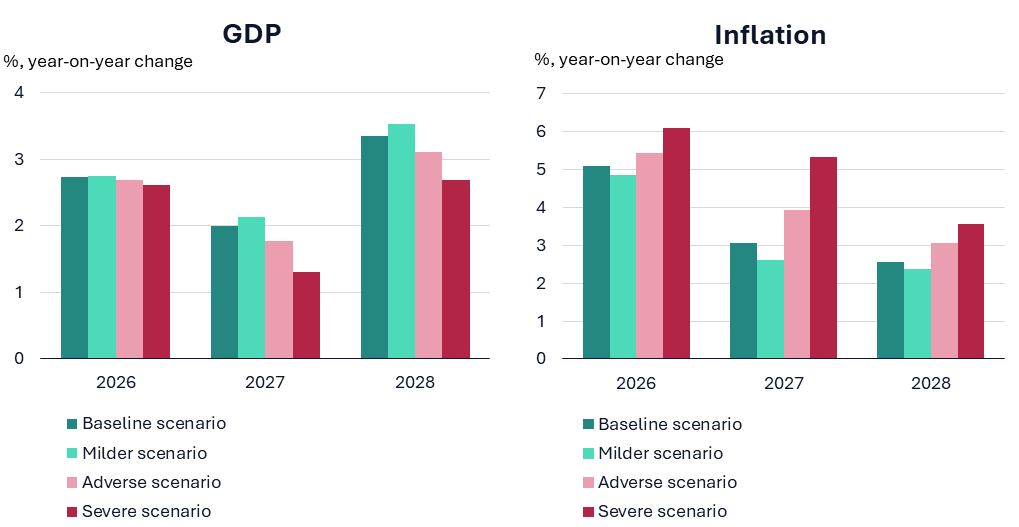
Sources: ECB, Eurostat, Statistics Lithuania and Bank of Lithuania calculations.
|
© Lietuvos bankas Gedimino pr. 6, LT-01103 Vilnius Reproduction for educational and non-commercial purposes is permitted provided that the source is acknowledged. ISSN 2783-557X (online) |