
2017-09-06
T. Šiaudvytis: Emigration rises slower than statistics suggest, yet the issue remains paramount

Foreign countries’ immigration data shows that the number of emigrants from Lithuania is most probably rising at a slower pace than officially announced. However, even if this is the case, the issue of emigration is a pressing concern, posing serious challenges to the labour market as well as the tax and pension systems.
Tomas Šiaudvytis, Senior Economist at the Macroeconomics and Forecasting Division of the Bank of Lithuania
Various reasons for emigration
According to official statistics, in the last couple of years emigration from Lithuania has once again picked up steam, even though after the economic crisis in 2009–2010 the number of official emigrants has been marking an annual decrease for four consecutive years. With wages in Lithuania showing an average annual growth of nearly 10 per cent, and unemployment reaching an exceptionally low rate (last recorded at the end of 2005), one might ask: why does the number of residents looking for a better life abroad not edge downwards?
Many will agree that emigration is primarily linked with economic reasons, the most important of which is the low standard of living in our country compared to that in the old EU Member States. Interestingly enough, emigration data for the past few years has been underpinned not only by economic but also legal and administrative reasons.
Statistics show that in 2015 the number of emigrants rose by a fifth, or 7.9 thousand, which is a considerable growth rate. However, emigration of Lithuanian citizens attributed only to a half of this increase. The remaining part mostly consists of the 3.1 thousand Russian, Ukrainian and Belarusian citizens that left our country. Their emigration might be partly driven by stricter regulations regarding issuance of temporary residence permits. The tighter regulations reflect the aim of our institutions to ensure a more effective control of illegal migration, especially by limiting legal yet fictitious activities in the Republic of Lithuania.
Another factor that may broaden the gap between the real and the official emigration rate in the recent years is the call for residents to check whether they owe SoDra, the Lithuanian state-run social insurance fund, for compulsory health insurance. Seeking to avoid indebtedness, residents declared emigration when SoDra took firmer actions, i.e. in 2016–2017, although they might have emigrated long before that, for example, in 2011–2015.
Hence in recent years the real emigration growth rate has most probably been slower than statistical data suggests. Even though this does not change the total number of emigrants that has been recorded since the 2011 census, it shows that the situation is not necessarily deteriorating to such an extent that is officially announced. Currently statistics most likely overestimate the true scale of emigration, however, in 2012–2014 the scale was underestimated.
Foreign data reveals a somewhat different situation
Foreign statistics, encompassing data on Lithuanian resident arrivals, also show that the overall situation might not be as bad as may seem. For example, emigration of a Lithuanian resident to Norway is included not only into Lithuania’s emigration statistics, but also into Norway’s immigration statistics. Some countries publish similar data on Lithuanian residents applying for a social security number.
This helps evaluate the extent of Lithuanian resident emigration to the most popular destinations – the UK, Norway, Ireland, Sweden, Denmark, the Netherlands and Spain (these countries account for 71.4% of emigration from Lithuania). Such calculations, however, are not without fault, for example, emigration of a Lithuanian living in Norway to the UK would still be considered emigration from Lithuania.
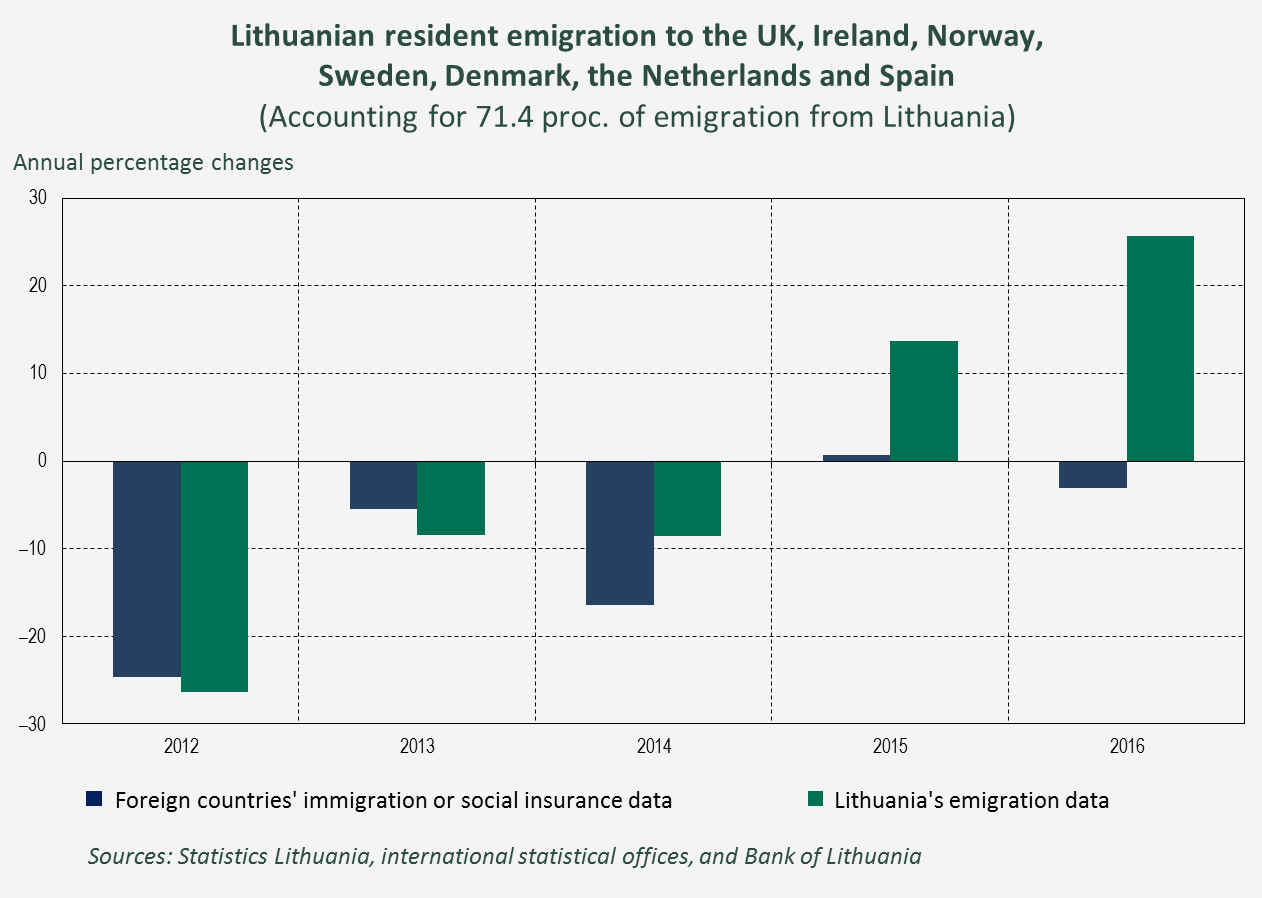
Nevertheless, foreign country immigration and social-security data show that emigration from Lithuania to the above-mentioned countries has most probably remained contained in the last couple of years. In fact, it could have only risen by 1 per cent in 2015, dropping by as many as 3 per cent in 2016. Lithuania’s emigration data reveals quite different trends: emigration to these countries in 2015 and 2016 spiked – by 14 and 26 per cent respectively (see Chart).
What actions should we take?
Although emigration in the last couple of years most probably expanded less than the official statistics suggest, this cannot undermine concerns over one of the most important economic issues. Even with data revision, net emigration per thousand of the population would still be one of the highest in the EU.
European Commission’s estimates, made under the assumption that the domestic social and economic policies, which are closely related to emigration, will remain unchanged, are worrying – it is projected that in the next 30 years the total number of residents in Lithuania will drop to 2 million. Such potential demographic changes undoubtedly are and will be a serious challenge to the domestic labour market as well as tax and social-security systems. Therefore, it is necessary to take immediate action and implement structural reforms: restructure the education, tax and social-security systems as well as fight corruption, income inequality and social exclusion in a more effective manner. Solving these problems could spur the rise in the living standard, one of the main drivers of emigration, in Lithuania.