
2015-11-30
Survey: Geopolitical tensions remain the most important risk to the domestic financial system, yet they are reducing

Financial institutions operating in Lithuania consider geopolitical tensions in the East and the protracted period of low interest rates to remain the major risks to Lithuania’s financial system, shows the survey conducted by the Bank of Lithuania. However, new and never before indicated risk sources were also mentioned in the latest survey.
‘For over a year now, the conflict between Russia and Ukraine has been viewed as the most prominent risk source to the domestic financial system. However, since the tensions in the East are reducing, financial institutions also indicated other events that could have a negative impact on the financial system, e.g. the aggravation of the refugee crisis in Europe and the slowdown in the economic growth of China,’ said Simonas Krėpšta, Director of the Financial Stability Department of the Bank of Lithuania.
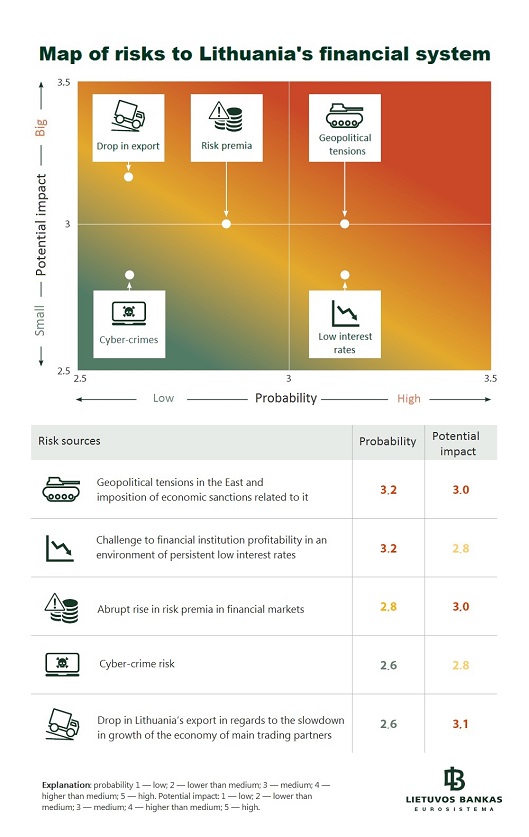
Geopolitical tensions in the East and the imposition of economic sanctions related to them are still considered to be the major risk source; however, in comparison to the results of the survey performed half a year ago, both the probability of such risk and its potential impact on the financial system are seen as decreased. In addition, when asked to indicate an event most likely to negatively impact the domestic financial system in the near future, financial institutions most often indicated the aggravation of the refugee crisis in Europe and not the conflict between Russia and Ukraine, even though the potential impact of the former risk would most likely be indirect.
Among other important sources of risk, the surveyed financial institutions indicated risks related to the protracted low interest rate period and reduced risk premia in the financial market. The surveyed banks and insurance undertakings viewed the challenge to financial institution profitability in an environment of persistent low interest rates as more prominent. Other financial institutions viewed the risk related to an abrupt rise in risk premia in financial markets as one of the most important. Since fluctuation in the financial markets increased, the possibility of the latter risk increased significantly.
Cyber-crime risk was also seen as one of the most significant risks. In comparison to other surveyed enterprises, banks viewed it as more important — they indicated that it is one of the most likely risks. The surveyed enterprises identified greater investment in computer system security and more active state involvement in developing a cyber-security system as risk mitigation measures. The strengthening of the security of electronic financial operations is one of the Bank of Lithuania and market participants’ priorities, whereas after the implementation of the new security requirements for online payments , next year bank customers will be provided with more secure identification means.
Financial institutions are least concerned with the risk related to a loan and real estate price bubble. Financial stability in this area was also strengthened by the Bank of Lithuania approved amendments to the Responsible Lending Regulations, which came into effect as of November and will screen too risky lending for house purchase transactions. Having decreased the maximum maturity for a loan to 30 years and obligated banks to verify the abilities of borrowers to repay the loans after a possible interest rate jump, the risk of over-indebtedness is reduced. At the same time, possibilities for price bubbles to grow would be limited, such as those prior to the crisis, when a large number of real estate transactions were financed via irresponsible lending and borrowing.
In order to assess the views of Lithuania’s financial institutions towards the domestic financial system and likely challenges to its sustainable future development, the Bank of Lithuania conducts a survey of risks to Lithuania’s financial system. This Survey is conducted on a biannual basis. Banks, insurance undertakings, leasing companies, management companies and other financial institutions assess the sources of major risks to Lithuania’s financial system, the probability of the occurrence of adverse events and their likely impact on the domestic financial system over the upcoming six months. A comprehensive review (653.9 KB download icon) of the survey is posted on the website of the Bank of Lithuania.