
2017-05-10

Having long used internal resources-based business financing, enterprises are gradually turning towards credit institutions, as reflected in the most recent survey of the Bank of Lithuania.
‘We are observing new trends in the behaviour of enterprises as they consider which resources to finance their business with. Enterprises which intend to finance their business needs using internal resources alone declined by 13 per cent in number. This is the largest change in more than two years,’ Petras Dubinskas, Senior Economist of the Macroprudential Analysis Division at the Bank of Lithuania, comments.
While enterprises’ assessment of credit institution lending conditions is similar to that a year ago, enterprises which reported that credit for business is fully or partly limited declined by 14 percentage points in number, as compared to the survey conducted a year ago. Moreover, the number of enterprises which intend to finance their business needs with internal financial resources alone dropped from 57 per cent to 44 per cent.
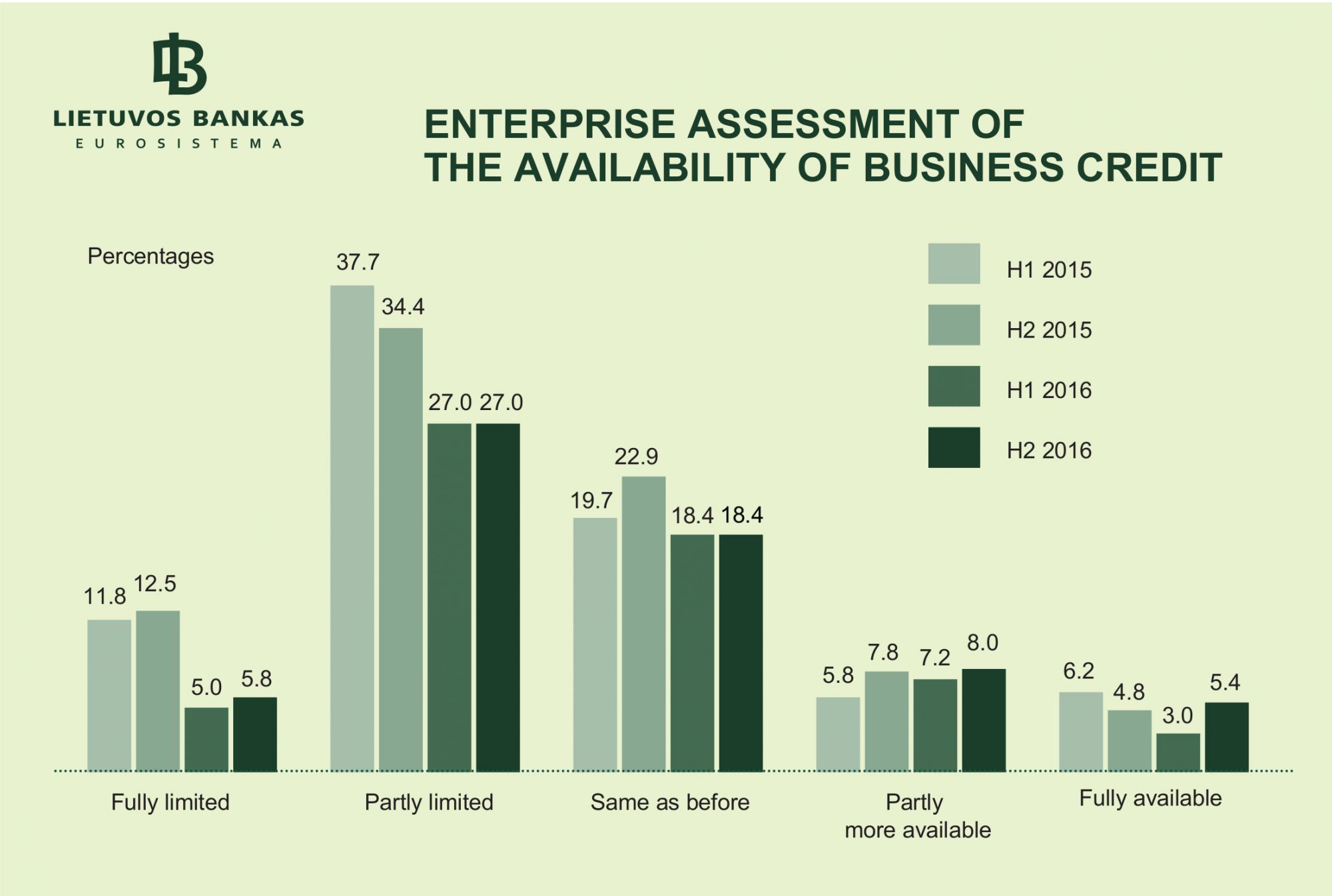
About 14 per cent of surveyed enterprises claim that their borrowing needs will in the near future increase, which is an increase of 5 percentage points from the previous half-year. Small enterprises and trade enterprises (60% and 55% respectively) mainly tend to finance their business with internal resources alone. As previously, the main factors behind such a decision were sufficient internal resources (44%) and the high price of credit offered by credit institutions (25%).
More than a third of enterprises (34.5%) with debt obligations last year applied to banks for a new loan or asking to change the terms and conditions of existing loans. Banks fully satisfied more than half (52%) of such applications, lent the entire amount requested for one-third of enterprises (31%), but under additional conditions, and rejected only 3.2 per cent of applications. The latter indicator fell by 9 percentage points (from 11% to 3%). This is suggestive of features of the easing of the terms and conditions of credit to enterprises.
Nearly three-fourths of enterprises with loans from banks (71.7%) have currently asset-backed their obligations, about a fourth (26.7%) secured them with warranty from natural persons.