
2016-06-14

According to the forecasts of the economists of the Bank of Lithuania, the Lithuanian economy this year is growing faster than last year and will outpace economic growth in Latvia and Estonia next year. While economic development is sustainable and consistent with the Bank of Lithuania’s previous assessments, it is, however, increasingly important to monitor changes in the labour market, where growth in wages and salaries has outpaced labour productivity for 3 years already.
‘When income rises, people are happy. However, the competitiveness of Lithuanian enterprises may weaken over time due to increased expenditure for employee wages and salaries, which could lead to worse prospects for their expansion, notably within the export sector. This in turn could negatively affect the country’s economic expansion,’ says Raimondas Kuodis, Deputy Chair of the Board of the Bank of Lithuania, commenting on the insights published in the Lithuanian Economic Review.
According to R. Kuodis, ensuring sustainable economic growth requires not neglecting the underlying factors behind economic growth, i.e. making the education system more effective and gearing it towards long-term needs of the labour market, promoting innovations and investment, making effort to ensure labour market flexibility.
The general image of the Lithuanian economy is improving this year: domestic demand strengthens, export performance improves. ‘With positive trends being observed, we project strong growth in the domestic economy both this year and next year – of 2.6 and 3.3 per cent respectively. This year, it will be the strongest economic growth in the Baltic States,’ says Gediminas Šimkus, Director of the Economics and Financial Stability Service at the Bank of Lithuania. According to the forecasts of the central bank of Latvia (Latvijas Banka), Latvia’s economy will grow by 2 per cent this year. The central bank of Estonia (Eesti Pank) has published an even lower forecast: Estonia’s GDP will grow 1.8 per cent this year.
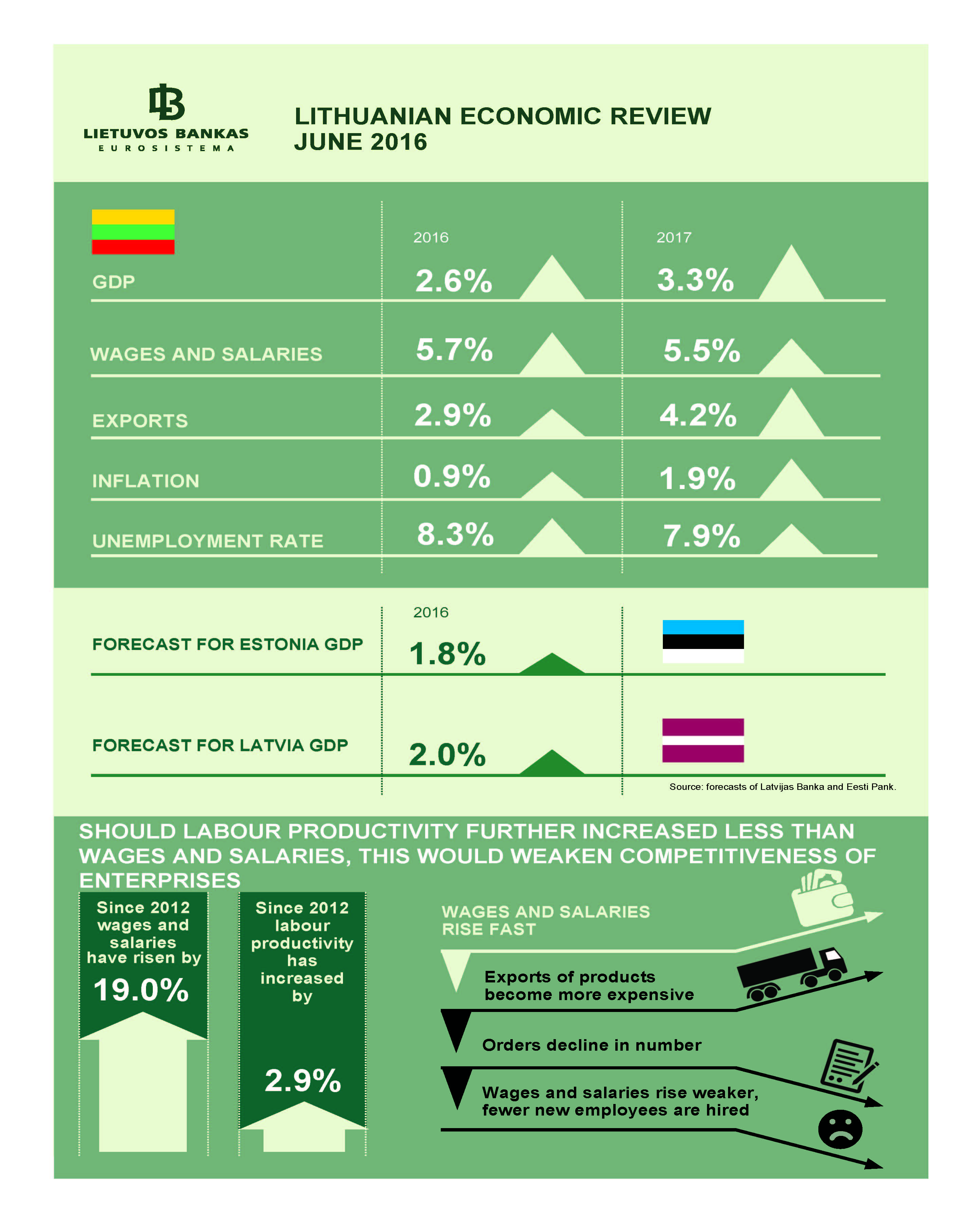
In addition to exports, Lithuania’s economic expansion is also driven by domestic demand, which is driven by rising wages and salaries. In the last three years, wages and salaries picked up by about 5 per cent each year, while this year, annual wage growth is likely to accelerate even more – to 5.7 per cent, due to the decrease in the unemployment rate and rising minimum monthly wage. Employee positions while negotiating their wages strengthen due to increasing job vacancies as well: their number is currently 16.3 thousand (13.1 thousand a year ago).
Declining unemployment also encourages greater consumption: in the first quarter of this year, the employment rate in Lithuania rose by 2.5 per cent, while the unemployment rate fell to 8.3 per cent over the year. According to the calculations of Bank of Lithuania economists, private consumption expenditure is likely to rise by about 4.3 per cent this year.
Persistently low interest rates have been affecting Lithuania’s economy in several aspects. First of all, they boost the housing market. Secondly, households borrow more amply for consumption needs and save when paying interest. In the second half of 2015, approximately a sixth of consumption growth was financed with a more ample financial flow from financial institutions.
The Bank of Lithuania increases the forecast for this year’s inflation by 0.4 p.p., to 0.9 per cent. This change is driven by oil price increases above expectations. Food prices grew as well, but vegetable and fruit prices, the fluctuations in which are always particularly pronounced, grew the most.
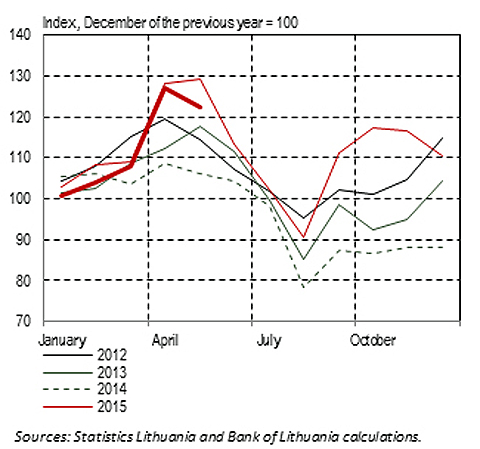
Global economic growth has decelerated and this year will not gain momentum yet. However, the situation in the euro area has been improving for some time already, with about 42 per cent of goods of Lithuanian origin being exported to it. The euro area economy is projected to grow by 1.6 per cent this year.
Russia continues to face a recession, but the situation in it has not been deteriorating as fast (the GDP contracted by 1.2% over the first quarter of this year, from 3.7% last year). The transportation sector, after incurring significant losses due to the situation in Russia, has re-geared a significant portion of its business from the East to the West; as a result, transportation volumes expanded by 13 per cent at the end of last year.
The Lithuanian Economic Review is prepared and published on a semi-annual basis; it deals with the dynamics of the real sector, prices, public finance and credit in Lithuania, assesses the prospects of Lithuania’s economic development. On the Bank of Lithuania’s website you can get acquainted with the latest macroeconomic forecasts and the Lithuanian Economic Review.