
2014-12-06

The Bank of Lithuania has prepared educational and methodological material on the euro for both pre-schoolers and schoolchildren of different age groups. It was prepared based on the principle that schoolchildren of different age groups do not equally absorb educational material.
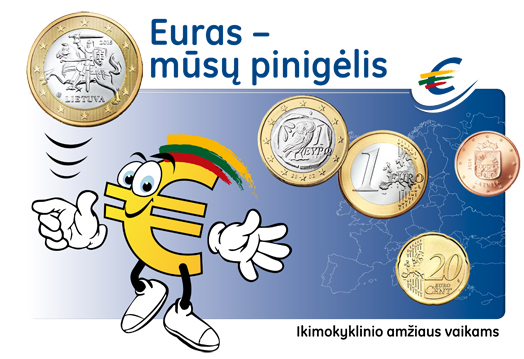
“Children are our future just as the euro is our future currency, thus the younger generation must learn about it. Plus, this subject is relevant to children. Children’s questions about the euro differ from those of adults. For example, as less than one month remains until the euro adoption, they start negotiating with their parents the rate at which their pocket-money will be ‘converted’ next year, asking why coins are different in size or how big a purse will be needed to hold 500 euros,” claims Vita Beržiūnaitė, senior specialist at the Money Museum of the Bank of Lithuania, who has prepared this material.
The material consists of a lecture for pre-schoolers, two sets — of the lecture “Get to Know the Euro” and an exercise book for schoolchildren in two age groups (8–15 and 16–18), one for each, as well as a quiz and video clips. Once the lectures have been delivered and the video clips shown, it is recommended that the schoolchildren fortify this knowledge and fill in their exercise books and play the quiz.
The education material “The Euro — Our Money” for pre-schoolers consists of a lecture alone, since filling in exercise books is too difficult for children in this age group.
The material has been published on the website of the Development Centre at http://www.upc.smm.lt/euras/.
The link to it is distributed directly to teachers, free of charge, through the electronic learning networks Mano dienynas and TAMO.