
2025-08-06
Despite a rapid decline in interest rates on loans, they remain among the highest in the euro area

Lietuvos bankas published a comparison of interest rates on new loans of Lithuanian and euro area credit institutions (banks and credit unions) and deposits with agreed maturity (term deposits) in June 2025. Charts include euro area countries whose data are published on the website of the European Central Bank (ECB). Find more detailed data on the ECB Data Portal.
Please note that interest rates on new business1 of loans of credit institutions operating in Lithuania and deposits as well as volumes thereof cover loans granted to euro area residents and their deposits.
Interest rates2 on loans and new business of deposits with agreed maturity of euro area credit institutions to euro area residents published by the ECB show that:
- In June 2025, the interest rates offered to households (residents) on deposits with agreed maturity in Lithuania remained close to the euro area average;
- a comparison of the data for June 2025 and March 2025 shows that all interest rates on deposits and loans examined have decreased in Lithuania;
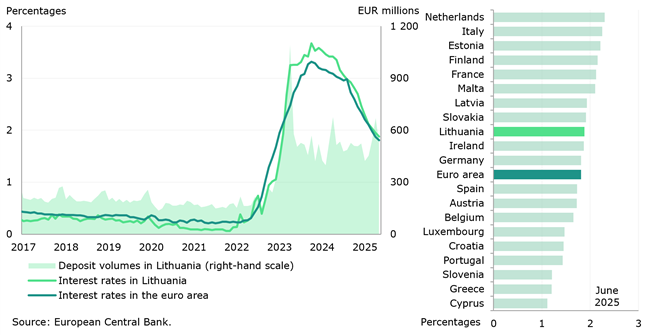
- the interest rates on household deposits with agreed maturity with credit institutions operating in Lithuania and their euro area average declined by 0.24 percentage points and 0.30 percentage points respectively in three months, to 1.88% and 1.81% respectively. Lithuania remained in the ninth position during this period (see Chart 1);
| Chart 1. Interest rates on and volumes of new business of household deposits with agreed maturity |
 |
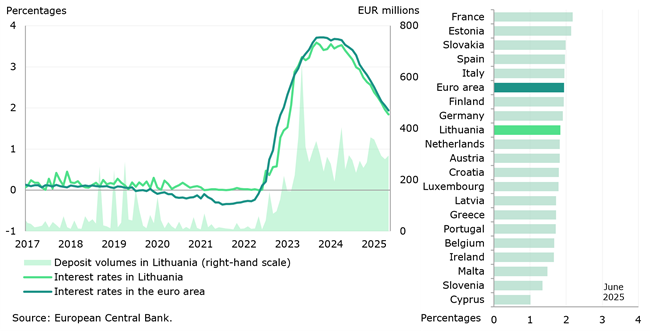
- both the interest rates on non-financial corporation deposits with agreed maturity with credit institutions operating in Lithuania and their euro area average declined by 0.42 percentage points and 0.39 percentage points respectively in three months, to 1.84% and 1.94% respectively. Lithuania retained the eighth position in terms of interest rates, remaining below the euro area average (see Chart 2);
| Chart 2. Interest rates on and volumes of new business of non-financial corporation deposits with agreed maturity |
 |
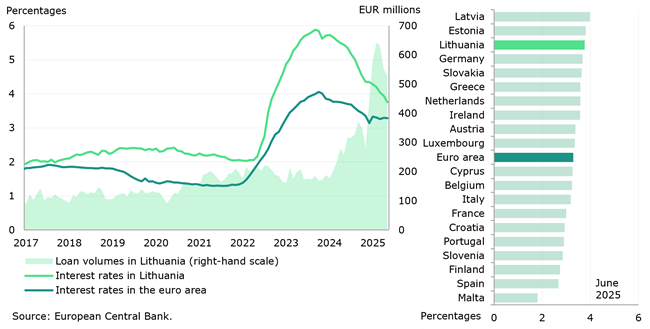
- the interest rates on housing loans granted by credit institutions operating in Lithuania to households and their euro area average declined by 0.44 percentage points and 0.02 percentage points respectively in three months, to 3.76% and 3.29% respectively. Lithuania remained in the third position (see Chart 3);
| Chart 3. Interest rates on and volumes of new business of household loans for house purchase |
 |
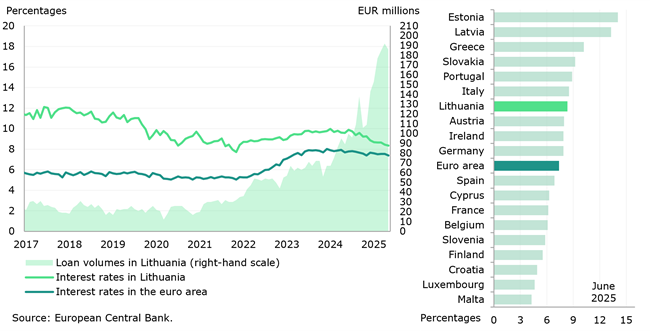
- both the interest rates on loans for consumption granted by credit institutions operating in Lithuania to households and their euro area average dropped by 0.31 percentage points and 0.12 percentage points respectively in three months, to 8.34% and 7.4% respectively (see Chart 4);
| Chart 4. Interest rates on and volumes of new business of household loans for consumption |
 |
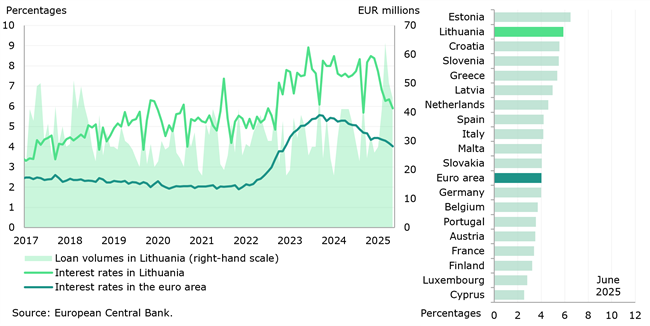
- the interest rates on loans for other purposes granted by credit institutions operating in Lithuania to households and their euro area average decreased by 0.92 percentage points and 0.33 percentage points respectively in three months, to 5.9% and 4.02% respectively. Lithuania remained in the second position among euro area countries in terms of interest rates (see Chart 5);
| Chart 5. Interest rates on and volumes of new business of household loans for other purposes |
 |
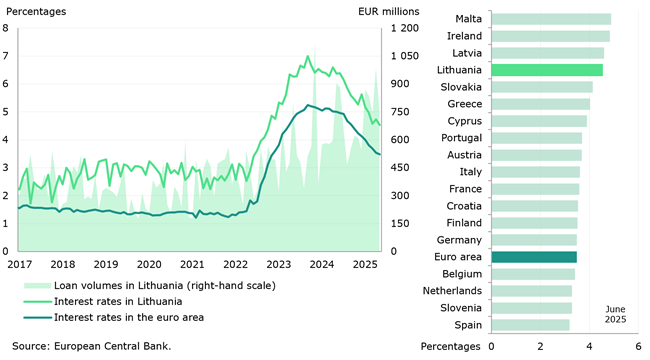
- in three months, both the interest rates on loans granted by credit institutions operating in Lithuania to non-financial corporations (companies) and the average interest rates on these loans in the euro area decreased by 0.45 percentage points and 0.33 percentage points respectively, to 4.53% and 3.48% respectively. In Lithuania, however, these rates are among the highest in euro area countries, i.e. 105 basis points above the euro area average (see Chart 6).
| Chart 6. Interest rates on and volumes of new business of loans to non-financial corporations |
 |
1 Weighted interest rates on new business during the reporting month, in percentages per annum.
2 New business covers financial contracts that specify for the first time the interest rate on a loan or the deposit rate, and contracts for existing loans or deposits, which were renegotiated. New business does not cover revolving loans and overdrafts, as well as credit card debt. New business deposits do not cover automatic renegotiations of existing deposit contracts.
3 Comparison of data of March and June 2025.
Download in PDF (307.2 KB download icon)