
Financial literacy is one of Lietuvos bankas’ key priorities. We believe that a financially literate society makes more informed decisions, contributes to sustainable economic growth, and strengthens overall financial stability. To promote these goals, Lietuvos bankas has established the Centre for Financial Literacy, which coordinates initiatives, research, and educational activities aimed at improving financial knowledge and skills among people of all ages.
In 2023, at the initiative of the Centre for Financial Literacy, 14 April was recognised as the National Day of Financial Literacy.
The goal of this day is to raise public awareness of the importance of financial literacy and encourage Lithuanian residents to improve their financial knowledge, skills and behaviour.
Various events have been held to mark this day, including:
- In 2023, the results of the Financial Literacy Survey among Lithuanian residents were presented, and citizens received kite-shaped pins, the official symbol of the National Day of Financial Literacy. More information (in Lithuanian) is available here.
- In 2024, a hiking event was organised in Kaunas, with nearly 2,000 Lithuanian residents taking part in a 5 km or 10 km walk while learning about financial literacy. More information (in Lithuanian) is available here.
- In 2025, the slogan “Develop your financial character!” was used to encourage people to recognise the importance of financial literacy, learn how to better manage their finances, and make informed financial decisions. An online discussion titled “How to Create Your Financial Future” was held, and residents were invited to take a test to assess their individual “financial self”. More information (in Lithuanian) is available here.
 |
Lithuania is the national coordinator of Global Money Week (GMW). GMW takes place every year in March and is dedicated to children and youth of all ages. Lithuania actively participates in GMW and places a strong focus on partnership, continuously cooperating with state authorities and financial institutions, associations, schools, universities, colleges, vocational schools, training centres, libraries, kindergartens, and institutions supporting people with disabilities. Every year, a growing number of organisations take part, including about 200–270 schools approximately 20 financial institutions, associations, public bodies, and others. On average, an audience of 100,000–450,000 people is reached annually during GMW through social media and online events (webinars, podcasts, lectures, etc.). |
Since 2023, Lithuania has hosted an average of 240 various events each year during GMW, focusing on finance, saving, and money. These include discussions, quizzes, competitions, exhibitions, creative workshops, excursions, educational sessions, open days, and movie nights on financial topics, and other activities.
The Centre for Financial Literacy of Lietuvos bankas also organises a programme for each GMW. Lietuvos bankas primarily holds its events online to ensure they are accessible to people living in the regions.
GMW is fairly widely covered by Lithuanian media on news portals and television.
More about what is happening in Lithuania during GMW can be found here.
 |
Lithuania is the official national coordinator of the World Investor Week (WIW). WIW is a global initiative that takes place every October to raise awareness about investing. Lietuvos bankas brings together the Lithuanian investment community, including financial market participants, educational institutions, and public authorities. The main goal of participating in WIW is to consistently educate the public about financial products, services, investment, and associated risks. It is crucial to ensure that as many people in Lithuania as possible understand investing and actively plan for their financial future. |
Every year, the number of partners participating in WIW in Lithuania grows, reaching almost 30 participants in 2025. They organise various activities and events related to investment such as open days, lectures, meetings, and even car orienteering competitions. Since 2022, investment information has reached an average audience of approximately 100,000 people each year through WIW online events (webinars, podcasts, lectures, etc.).
Each year, Lietuvos bankas introduces a new tool or resource to support learning about investment. In 2023 and 2024, it encouraged participation in quizzes, published memos on topics like crypto-assets, green finance, and resilience to fraud, and organised online lectures on investment fraud and its prevention. In 2025, a unique video lecture series titled “Investing ABC: Understand and Start” was launched, specifically designed for the general public.
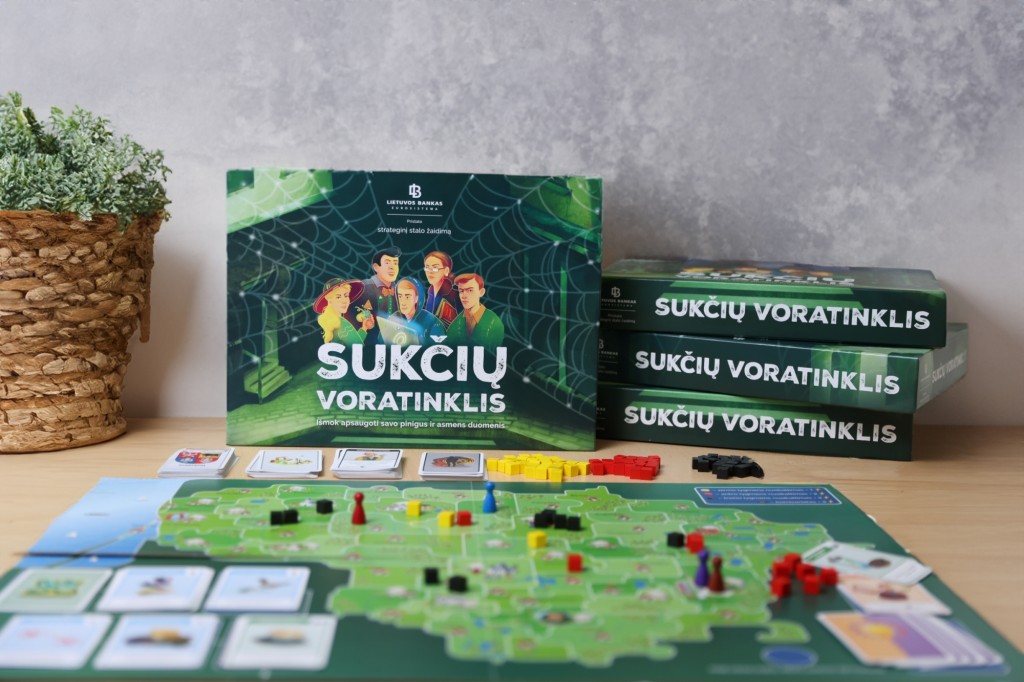
In 2023, the board game Sukčių voratinklis (Fraudster Web) was released. This strategic board game was developed as an inclusive tool to help residents learn how to recognise and protect themselves against financial fraud. It is the first board game dedicated to fraud prevention in Lithuania.
It is a fun way to learn how to recognise fraudsters while spending enjoyable time with family, friends, or colleagues. The game can be played by two to six people, aged 14 and above. The players’ goal is to take on the role of fraud catchers and eliminate the web of scammers spread across Lithuania.
The game presents different fraud scenarios that help players develop their fraud awareness and resistance skills. It also includes educational information and practical advice on how to avoid falling for scams, what types of fraud are most common, and what steps to take if someone does become a victim.
In 2024, at the PineCon 2024 board game festival, “Fraudster Web” was named the best board game developed in Lithuania by industry professionals. The game is available in all Lithuanian public libraries as well as in libraries of universities, colleges, vocational schools and secondary schools. These are public education centres that are accessible to every citizen. The fact that the game is available in libraries, together with books, shows that financial literacy is an integral part of the basic education that is essential for a modern person.
The project aims to enhance the digital financial literacy and resilience to financial fraud of the Lithuanian and Latvian populations. It brings together the European Commission, the Organisation for Economic Co-operation and Development (OECD), the central banks of Lithuania and Latvia, and other representatives from the financial and security sectors.
The project seeks to provide and implement an action plan that would encourage behaviours leading to increased financial security, sustainability, and well-being for the population of Latvia and Lithuania. Focus is placed on educating the public on digital financial tools and enhance awareness of risks of fraud, with the objective of improving behaviours and habits to seamlessly weave this knowledge into everyday life.
A quantitative survey on the digital financial literacy of adults was launched under the project. The survey delved deep into the digital financial knowledge, behaviours and attitudes of the Lithuanian and Latvian populations. Additionally, a qualitative study exploring the profiles of financial fraud victims, their experiences, and factors affecting fraud cases will be conducted for the first time in Lithuania and Latvia. The data will be analysed by the OECD and will be used to develop an action plan.
More information is available here.
Last update: 13-11-2025